‘a Beacon of Peace’: London’s Oldest Mosque Celebrates Centenary
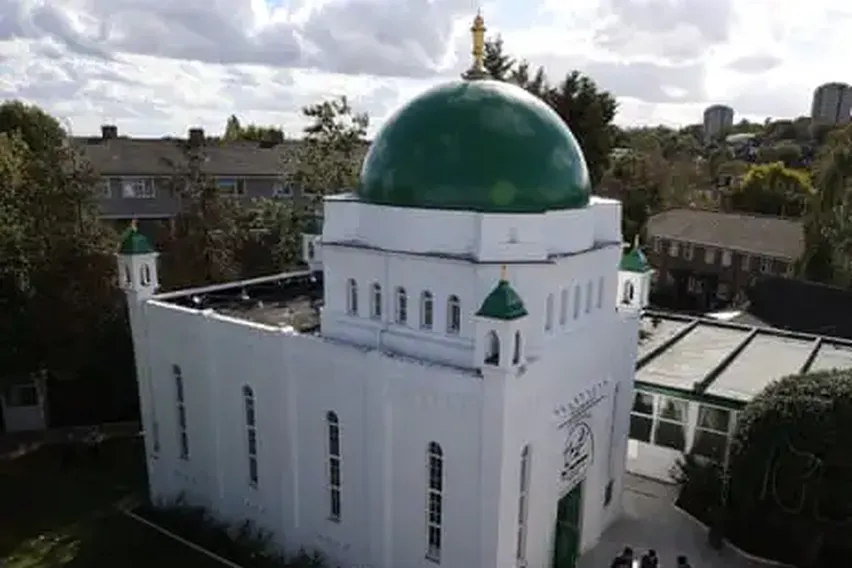
Exactly 100 years ago the Guardian wrote about the opening of London’s first mosque, an impressive white building surrounded by immaculate flower gardens in the heart of south London suburbia.
A report described the mosque, in its incongruous surroundings, as “a thing of beauty”. The journalists who attended the opening ceremony witnessed the mosque’s large black doors being opened with a silver key. About 600 eminent guests attended the grand opening.
Ahead of centenary celebrations at the Fazl Mosque in Wandsworth, also known as London Mosque, there is lots of activity taking place. Putney Labour MP Fleur Anderson pops in and speaks about how well loved the mosque, which is home to members of the UK’s Ahmadiyya Muslim community, is in the area.
“No street party is complete without the wonderful food provided by this mosque,” she says.
According to Mahmood Rafiq of the Ahmadiyya Muslim Community UK, being part of the wider community is a key part of the mosque’s ethos. They give out sweets to local children at Eid, extend Christmas greetings to neighbours, help to keep the local environment clean and show support for other faiths if they are subjected to attacks
The mosque has been used for all sorts of other purposes alongside prayer, acting as an air raid shelter during the second world war, and more recently as a centre for blood donation and Covid 19 vaccinations.
Its core message is “love for all, hatred for none”, a message particularly pertinent in times of hostile political and religious divisions.
“Thankfully we haven’t experienced a lot of Islamophobia at this mosque,” says Rafiq. “But there has been an increase in incidents of low level harassment such as cars driving by and hooting their horns aggressively.”
The building, which is in the Southfields area, was granted listed status by Historic England in 2018. It appears little changed since it first opened a century ago, with its slim vertical windows, green dome and pristine white exterior. Splashes of colour from English roses still feature prominently in the gardens surrounding the mosque.
The purchase of land to build the mosque on was largely financed by a group of Ahmadi Muslims from Qadian in India, many of them women who sold their jewellery so that London’s first mosque could be established, even though they knew they would be unlikely to ever be able to visit the finished building.
Mosque leaders are billing the message of this significant birthday as “a century of connection”. To mark the anniversary, 10,000 free meals will be provided for homeless people.
Munir Dean, 65, a stalwart of the mosque, can trace its history through his own family, with his grandfather and father playing key roles in the mosque’s development. He said the founders of the mosque had a particular vision in the aftermath of the first world war of faith, peace and uniting humanity.
In its early days the mosque entertained visitors from high society such as Viscount and Viscountess Allenby, and had some very English traditions such as serving tea out of the finest china cups. “Visitors to the mosque were much more likely to be served scones with clotted cream than samosas,” he says.
In its early days when the UK’s Muslim population was much smaller than it is now there were no halal butchers around and instead people would pile into a car for the weekly treat of going to Blooms, the famous kosher salt beef restaurant in Aldgate East in London to tuck into meat sandwiches – kosher meat is accepted as halal because the methods of slaughtering animals are the same.
Bilal Nuttall, who grew up in the same street as Lancashire actor, singer and comedian Gracie Fields, converted to Islam after serving in the Middle East during the first world war and became the mosque’s muezzin calling the faithful to prayer. According to the mosque’s historical records, the imam of the mosque in the 1930s, Abdur Rahim Dard, played a pivotal role in developments leading to the establishment of Pakistan as a separate country from India.
Muhammad Ali Jinnah, an Indian politician and a barrister who trained at London’s Lincoln Inn Fields, was living in Hampstead at the time. According to Dean, he was “a very English gentleman” and a sharp dresser wearing the best Savile Row suits.
He had been advocating for the rights of Muslims in India but had become disillusioned and was considering remaining in the UK and continuing his career in law. Dard convinced him otherwise and he made a keynote speech in the Fazl Mosque gardens, which proved to be a turning point in India’s future and partition of then British India into independent India and Pakistan. He returned to India the following year and became governor general of Pakistan when it became an independent state in August 1947.
Mirza Masroor Ahmad, the current and fifth leader of the Ahmadiyya Muslim Community, says the mosque’s history reflects the principles of serving neighbours, showing loyalty to the UK and making peace with all people regardless of faith or background. “As we mark this centenary, I pray that the mosque may continue to be a beacon of peace and a means of bringing people together for generations to come.”
As the community reflects on the mosque’s last hundred years, Dean is looking ahead. “Our message is quite timeless. It has no expiry date. Bring on the next hundred years,” he says.